Cabal Coins: The Urge to Short the Top… Then Catch the Knife

Ah yes… the what the f*ck is this coin moment

Everyone has experienced this. You’re trading Bitcoin, majors, normal alts. There’s some logic, some correlation, some narrative, at least there’s spot flow behind it. Then one day you open Binance or Bybit, go to perps like a proper degen, and you sort by 24h change. Random tickers pop up. +60%, +100%, -50% (but still up hundreds % past few weeks). You look at it and think: what the hell is this?
You open the chart and something feels… off. The moves are weird. Sharp pumps, violent wicks, but also this slow, clean grind, up or down, everywhere. And the weirdest part? It doesn’t care what Bitcoin does.
So what are these coins? In this article I’ll break down what I call Cabal Coins, how to actually spot them, what metrics I track, and why they keep baiting you into the worst trades possible. Because trading these is different. The urge to short the top is strong. Then it dumps… and you try to catch the knife. And that’s exactly where most people get destroyed.
One thing upfront — if you’re shorting these, you better have a hard stop. Because upside is not rational here, and the cabal can push it way further than you can stay solvent.
What Are Cabal Coins?
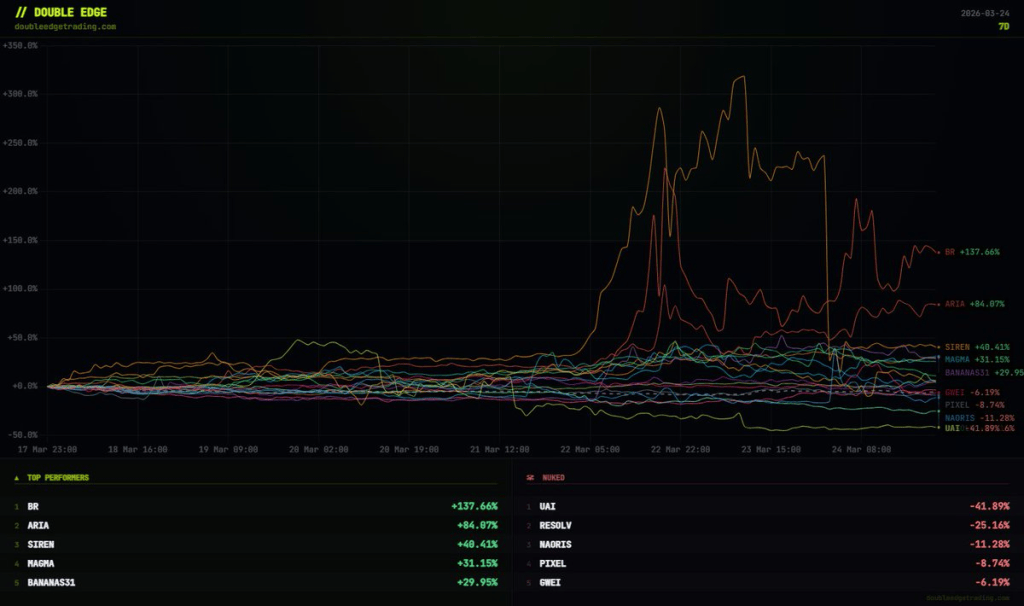
SIREN, BANANAS31 — perfect recent examples
I don’t think there’s one clean definition you can apply to all of these. In crypto, if someone wants to bend market mechanics, they’ll find a way. It gets creative.
So instead of a strict definition, I look for patterns. First thing I check is the project itself. What does the coin actually do? Most of the time… not much. It’s inflationary, the project could exist without the token, or it’s tied to something like gaming or DeFi where the token isn’t really necessary. Sometimes it’s just straight up useless.
Then I look at MC and FDV. I’m checking MC vs FDV, future unlocks, and most importantly, distribution. Sometimes one metric doesn’t explain everything. For example PIPPIN had MC = FDV, but still the distribution of wallets was absolute mafia. So it’s always about context, not just numbers.
What matters is how much supply is actually in circulation. With newer listings, you often have low spot flow, locked supply, and a large portion of tokens sitting in a few wallets. So even if it looks pretty thin on paper (CoinMarketCap), the real free float is even worse. And once spot flow is thin enough, it stops mattering. That’s when perps take over. Another metric worth tracking is the OI/MC ratio — how much leverage is in the system, and how sharp moves will be by definition.
Most of these tokens trade on smaller, sketchier spot venues like Bitget, Gate, KuCoin, MEXC, LBank or Bitmart, while missing major spot exchanges like Binance, Coinbase or Kraken. Usually coins on BSC chain. At the same time, they get listed on Binance or Bybit perps. That’s when the game really starts. You can see some of those coins already made 100%+, you want to short or you want to chase the pump, it’s a headache. But it’s important to check if there is TWAP on Binance perps — basically perp CVD — and if open interest is grinding while price stays flat or slowly grinds higher and doesn’t react to BTC.
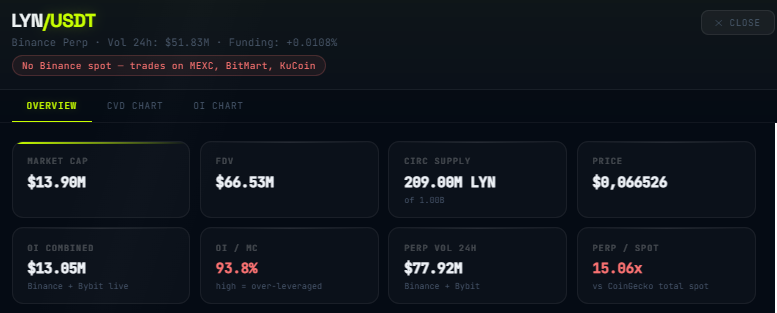
Because now price is driven by leverage, not real demand. Thin float, concentrated supply, perp dominance. That’s the environment Cabal Coins live in.
One last note. This is the most common setup, but not a rule. RIVER was a good example of an exception. Spot was controlled, mainly on Bitget, with thin order books constantly pushed higher — basically TWAP to infinity. At the same time, perps kept leaning short… and getting farmed. So instead of perps driving price, spot was squeezing them. That’s the point. This market is creative. Mechanics change. You need to recognize what’s in control and adapt. We didn’t even mention funding on these coins, which is lately mostly positive as perps chase them heavily, but mechanics can change and it can turn into a massacre in the books, like POWER — where it went from a cabal coin into a diabolic squeeze to billions FDV, a perp-driven short squeeze.

Let’s get into charts, real examples, and the tools to track this.
I’ll skip the part about finding these coins. It’s obvious once you know what you’re looking for, and I use my own screener that automates most of it. But doing it manually is simple enough.
Check the 24h gainers. Watch open interest changes. Track liquidations. That alone will already point you in the right direction.
For tools, I mainly use Velo.xyz, highly recommended. Coinalyze and Coinglass are solid too, and even CoinMarketCap works for basic filtering. That’s more than enough to start spotting these setups.
Here’s what you’re looking for:
1. Perp CVD grinding up non-stop, even through heavy corrections
Binance perpetuals CVD keeps climbing regardless of what price does on the dips. That divergence is the tell.
2. Recent Binance perp listing, especially BSC-native or spot-first coins
Newly listed perps are already interesting. But when the coin launched on BSC or only traded on spot venues like Bitget or Gate.io before the Binance listing? Even better signal.
3. Thin spot float
Low circulating supply, locked tokens, or supply concentrated in a handful of wallets. This makes the spot market easier to control and amplifies any move.
4. The price action signature
Usually it spikes sharply, then OI keeps grinding and CVD too — price just doesn’t react to it. It continues the slow grind while all that buildup sits there, ready to get taken out before the next move up. Varies a lot between setups though.
SIREN
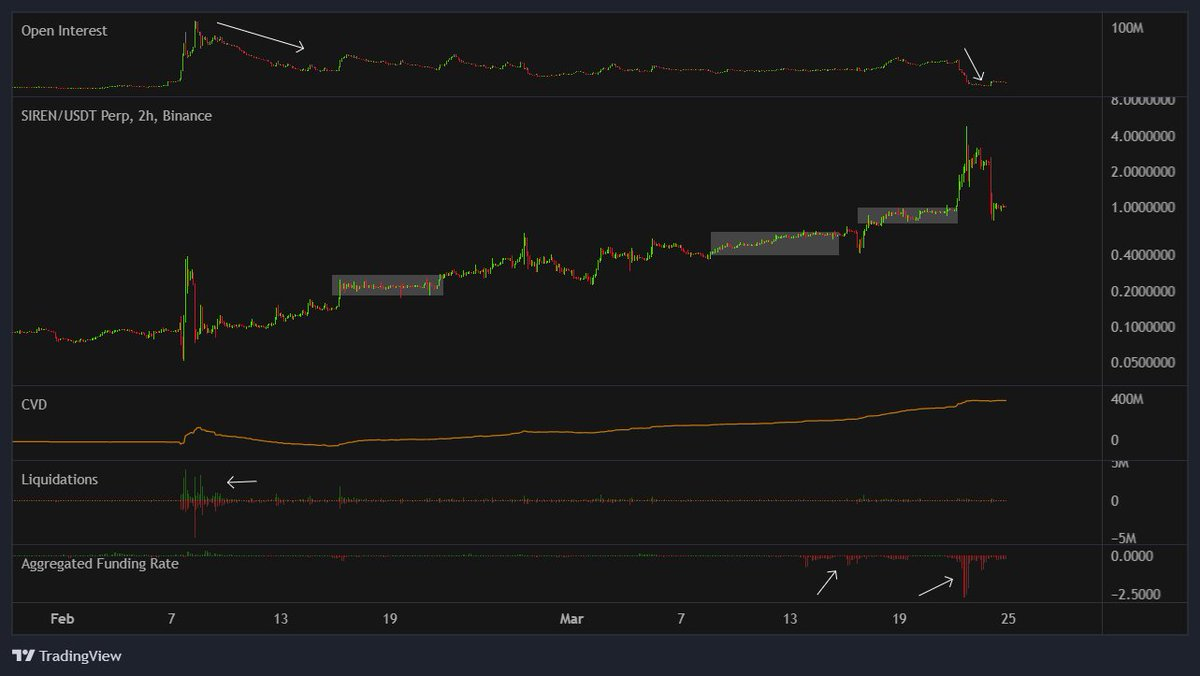
SIREN move started with heavy selling that wiped out longs, then flipped into a squeeze on shorts, and later dumped again to catch chasing longs. Unbelievable trigger, but from that point the slow grind just kept going.
CVD never really cooled off. Open interest was declining while price kept grinding higher. This is a classic setup where shorts are being forced in over time. Every time it feels like the move is done after multiple 100% pushes, it squeezes one more round, usually on extreme negative funding. On Bybit, which is the main venue for these liquidations, funding was around -4% every 4 hours.
After that final squeeze, they usually step back. The white boxes just highlight examples of controlled price action.
Let’s have a look at what we’re actually trading before the final squeeze:
MC ≈ $693M
Open Interest ≈ $119M
From wallets:
48% locked (Hedgey)
27% dead
23% cluster
Real float ≈ ~1–2% (≈ $7M–$14M)
Leverage in the system:
119M / ~10M ≈ 11–17x
Basically you’re looking at pure derivatives price discovery.
You can also check the spot markets listing and it becomes pretty obvious.

Price grinding higher with pullbacks, while perp CVD on Binance is going bazooka.

One last note on cross exchange squeezes. Bybit is still the main reference for less sophisticated traders who are willing to hold shorts with a wide buffer, even when price is already hundreds of percent above their entry. If you look at the funding before the final squeeze, it tells the story clearly. Most of the liquidations were happening there.

I’d also highly recommend using Bubblemaps on these BSC coins to track wallet movements, clusters, and Hedgey flows. It helps you get a sense of when the end might be getting close.
Before the final squeeze, Hedgey dropped from around 48% to 20% and started distributing into new wallets ahead of the dump. The volatility didn’t actually end there, it marked the top. And as always with these cabal setups, it can still get you if you’re not careful.

And they did run it back…

POWER
Before we go through the chart, some context on POWER.
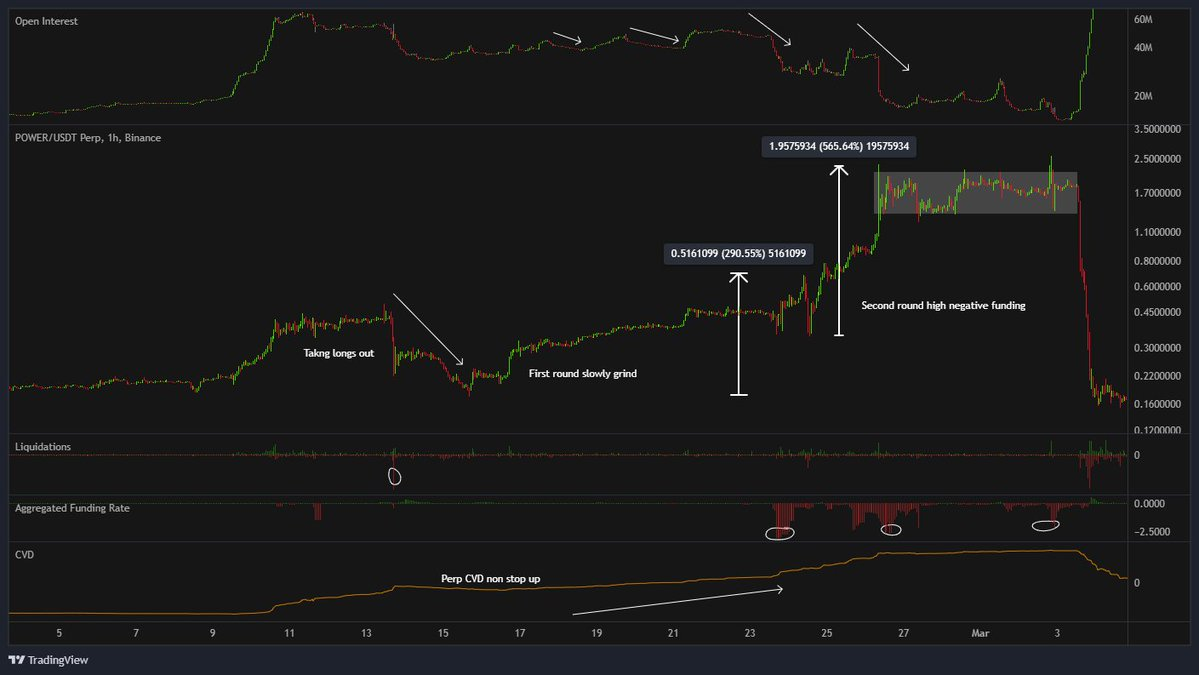
This was a high FDV coin with most of the supply locked. Main spot venue was Bitget, with no Binance spot listing. So right away you’re dealing with thin real float and a market that can be pushed around.
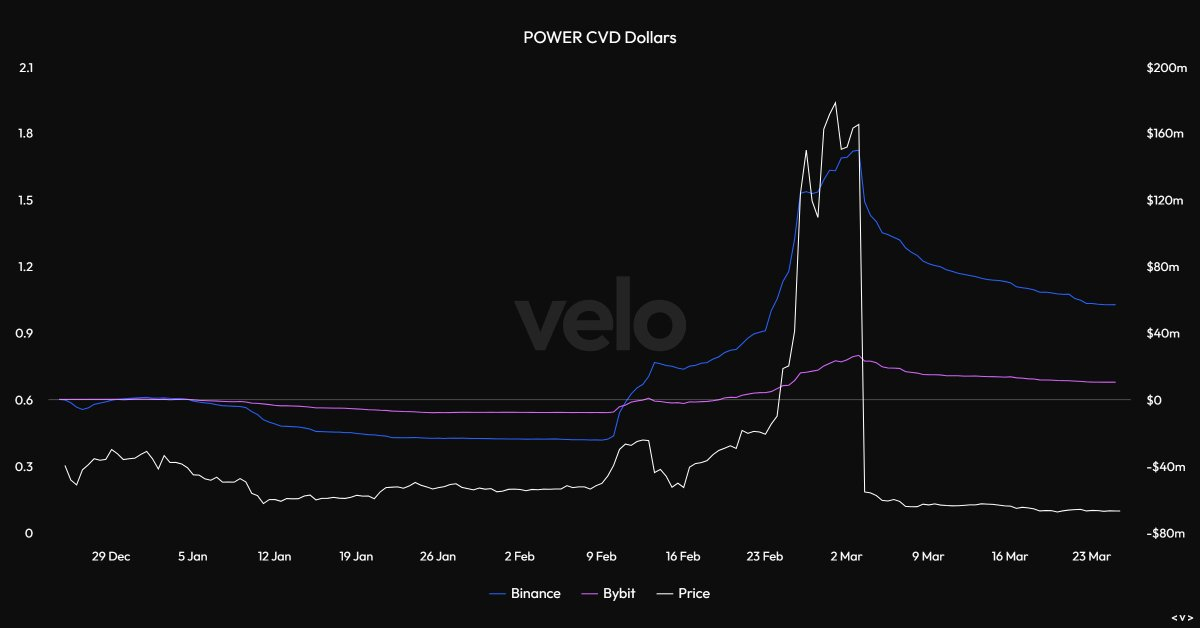
After the initial pump, price printed a classic bart. On the move down there was heavy long liquidation, followed by a slow bleed. But the interesting part was what happened in the background. Someone was clearly TWAPing on Binance perps the entire time and slow grind was on.
At some point momentum picked up and the slow grind started. That’s the first leg of the move, around 300%, where you start thinking there’s no way this keeps going higher… but it does.
For reference, these were the stats before the almost 600% breakout:
MC ≈ $200M
FDV ≈ $973M
Binance futures volume (24h) ≈ $600M+
At that point most people would say 1B FDV is the ceiling. It wasn’t.
The second leg came on extremely negative funding. In this case it was even more extreme than SIREN, because Bybit switched funding to hourly, averaging around –1.25%.
This is also where a lot of “look at my short PnL” posts stop making sense. Scaling into shorts can work, but you have no control over how long they keep this going or how funding evolves while you’re in the trade.
Example: –1.25% funding per hour on a $5k short = $62.5 paid every hour. Hold that for ~184 hours and you’re down $11,500 just on funding.
Below is a classic example of Binance TWAP driving the move.
UAI

This chart is a clean Cabal Coin example.
Price looks random, but it’s not. The move starts with OI expansion, then a long liquidation flush. After that, price stabilizes while perp CVD keeps grinding up non stop. That’s not spot demand, that’s positioning. Then the squeeze phase kicks in. Price moves up, OI drops at times, shorts getting forced out. Funding stays positive, but it doesn’t matter, squeeze continues. Finally you get the blow-off and hard unwind. Late longs get trapped, funding flips negative, and the whole move resets.
Key point: price isn’t driven by demand, it’s driven by leverage.

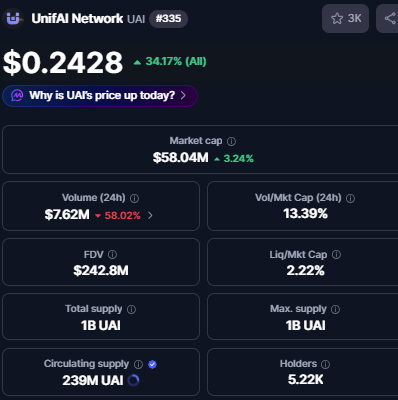
If you check the stats: high FDV, low MC.
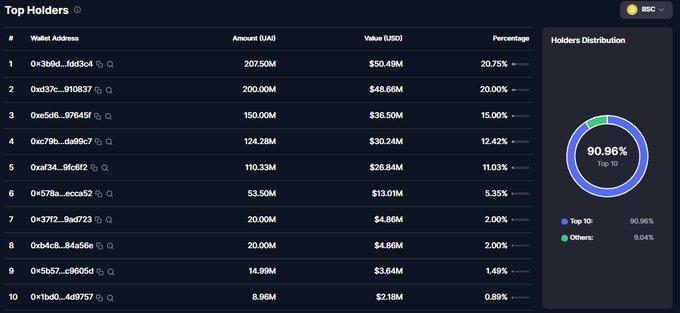
TOP 10 wallets holds 90% of the supply, the spot flow actually thinner than declared in this case. BSC Based.
What’s the point, and how do you actually make money once you understand who you’re trading against?
The whole point of this article was to show you what to look for before you open your gambling app, see something up 150% on the day, and decide to short it.
But yes, you can absolutely trade these. The volatility is great. The main thing to understand is that your edge on the short side is limited, even when you see people meme-posting their scaled shorts. There’s no structure, no real reference point in this market. Personally I eyeball MC milestones, liquidation clusters, vol spikes — things like that can be faded. But holding shorts with a huge buffer through hundreds of percent moves just doesn’t work for me. I know it’s a sizing argument, but the funding alone isn’t enough to justify it.
Joining the long side is psychologically painful on these coins and that’s understandable. You know you’re trading a scam. You know they can rug it at any moment. You’re impatient. But as the examples above show, when these things finally capitulate it’s really over. So looking for reversals with a tight stop actually makes more sense than most approaches here.
Scalping is respectable because the vol is never boring, but the books are thin so size is limited.
Know what you’re trading, know which side the pressure is on, and don’t be the one fading the people who built the whole thing.

If you’re into trading this kind of stuff, here’s your list as of writing. See you in the books.



[…] many altcoins, Cabal coins / altcoin trading → “Cabal Coins: The Urge to Short the Top” funding often tells you more about market structure and hedging flows than pure crowd […]